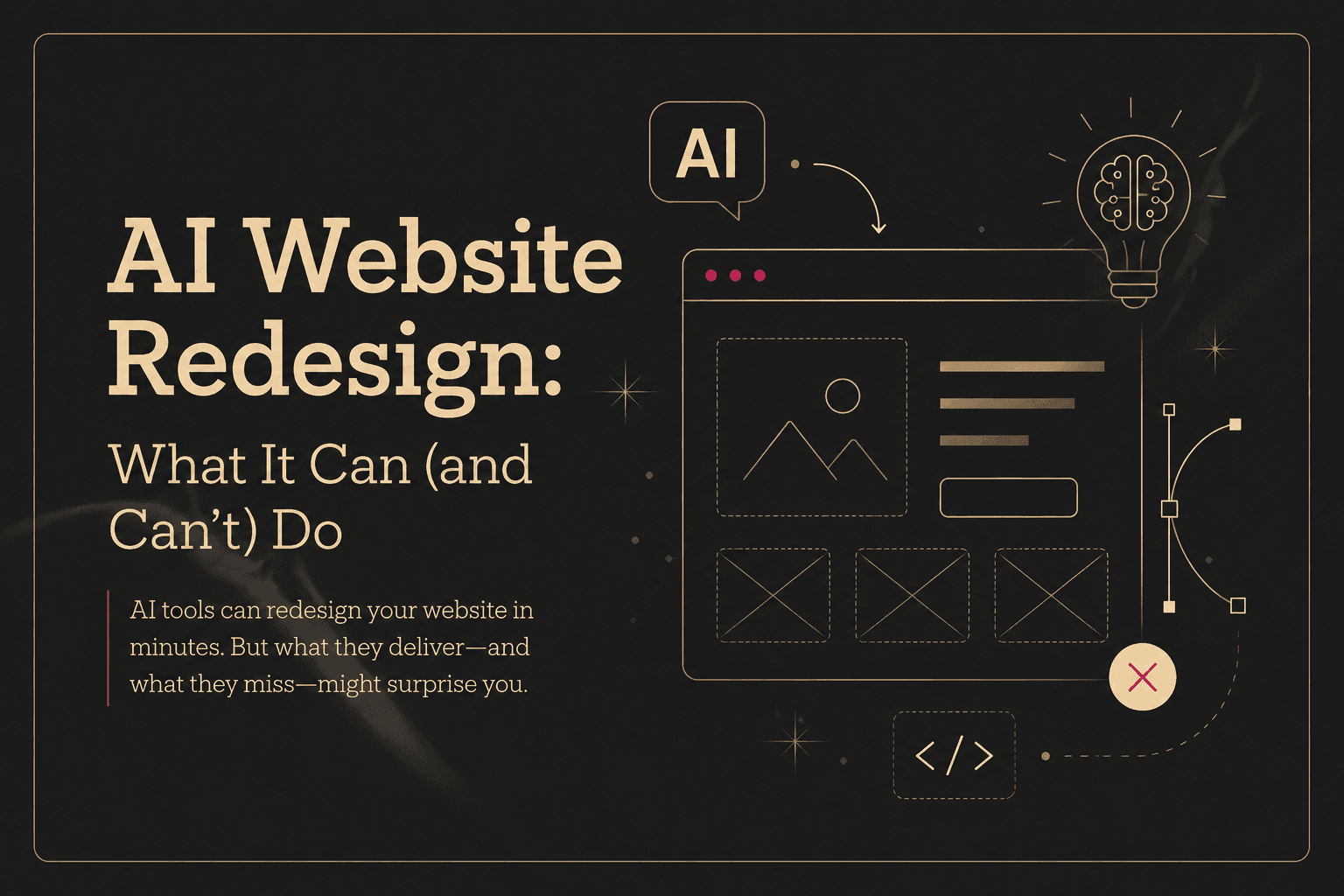
Every week, another tool promises to redesign your website in minutes. Paste a URL. Describe a vision. Watch AI generate something clean, modern, and apparently ready to launch.
The question is not whether AI can redesign a website. It clearly can. The question is what you actually get when it does, and whether that output does the job your business needs done.
Here is the honest breakdown.
What an AI Website Redesign Actually Does
AI website redesign tools follow a similar process across the board. You provide a URL. The AI scrapes your existing page, analyzing layout patterns, copy, heading structure, images, and color. It then generates a new visual treatment that preserves your content while replacing the design.
The output is usually clean HTML, a modernized layout, and a visual starting point that looks considerably better than whatever came before.
Tools like Durable and 10Web generate complete websites from a URL or prompt. Relume has carved out a strong position with AI-generated sitemaps and wireframes. Framer AI lets you generate layouts, write copy variations, and iterate directly inside a live design environment.
The speed is real. What used to take a design team several weeks to produce as a first pass can now appear in a few hours.
What AI Gets Right
Speed and first-pass layouts
AI excels at generating layout directions quickly. If you need to see three visual approaches before committing to one, AI can produce them in an afternoon. Figma's 2025 AI Report found that 68% of developers say AI improves their work quality, with most of the gains coming from faster iteration cycles rather than final production quality.
Sitemap and wireframe generation
Relume-style tools have genuinely changed how design teams structure new sites. Feeding in a brief and getting a logical sitemap back, with content blocks mapped out per page, is useful work. It is the kind of structural scaffolding that used to consume a full day of a strategist's time.
First-draft copy
AI can generate page copy, meta descriptions, alt text, and heading structures faster than any human. For sections like service descriptions or FAQ blocks, a strong AI draft is a legitimate starting point that a writer can sharpen into something specific and compelling.
Accessibility audits
Automated tools can check for WCAG compliance, flag missing alt text, test contrast ratios, and return a full audit in minutes. That is real, repeatable value. It catches the kind of issues that manual review can miss on a fast-moving project.
Rapid visual iteration
Testing a dark versus light treatment, trying a different hero structure, running through layout variations without rebuilding from scratch: these are cases where AI removes friction and compresses what used to be a multi-week feedback loop.
What AI Gets Wrong
This is where the honest conversation starts.
No brand thinking
AI tools have no access to your positioning. They do not know how you differ from your three closest competitors, what your customers are anxious about when they land on your site, or what your brand needs to feel like to the specific buyers you are trying to convert.
AI pattern-matches from its training data. The result looks modern because it is statistically similar to other modern websites. That is the problem. A website that resembles every other well-designed site is not differentiated. It is just current.
The generic problem
Because AI tools train on the same corpus of existing websites, they produce outputs that converge toward a visual center. If ten companies in the same space all use AI to redesign their sites this year, those sites will look like variations of each other. The competitive value of a strong, distinctive brand identity gets flattened by the same tool everyone else is using.
No conversion judgment
Conversion is not a visual decision. It is a strategic one. AI cannot tell you whether your primary CTA should appear above the fold or after the value proposition. It cannot decide whether to lead with a problem statement or a proof point. It cannot assess whether your headline will land with a CFO versus a product manager.
These decisions require knowing your audience, your sales process, and what actually moves your specific buyer. AI has no access to any of that context.
Integration complexity
Most websites that do real work have things running beneath the surface: CRM connections, tracking pixels, custom forms, analytics events, gated content flows. AI-generated redesigns handle the surface layer. The infrastructure gets left behind, and reconnecting it requires someone who understands both the code and the business logic underneath.
Code quality and performance
AI-generated code is often bloated. Unused CSS, redundant elements, and inefficient structure add weight to the page. A heavier page loads more slowly. Slow pages rank worse in search and convert worse for users. The output that looks clean can carry real technical debt under the surface.
The 80/20 trap
AI gets you to roughly 80% of a good website almost instantly. The remaining 20% is where conversion rate, brand impression, and search ranking actually live. Most teams underestimate how much work that last 20% requires, and how much it matters to the result. An AI redesign that stops at 80% looks finished. It just does not perform.
Who AI Redesign Tools Actually Work For
Used in the right context, AI earns its place.
Founders validating a direction can use AI to test whether a new positioning or visual identity resonates before committing to a full build. The cost is low; the speed is real.
Design teams in the ideation phase get the most from AI as an exploration tool, not a production tool. Generating six layout directions and developing the strongest one is a smart use of the technology. Shipping the raw output is not.
Low-stakes pages — internal tools, event microsites, and informational pages with limited conversion goals — are cases where the 80% AI delivers is often enough for the job.
Some early-stage teams use AI-generated sites to move fast before securing funding. The tradeoff is deliberate: speed now, a more considered website when the stakes rise.
Who Needs More Than AI
Companies where the website is a sales asset. If your website is what a prospect reads before deciding whether to take a call, the quality of that experience directly affects revenue. A pattern-matched design and generic copy will not close the gap between you and a competitor with a stronger, more specific brand.
Brands that need to look different. If your competitive advantage is quality, taste, or a strong point of view, your website needs to express that visually and in the writing. AI cannot manufacture differentiation. It can only simulate what already exists in its training data.
Sites with custom requirements. Rich interactions, scroll-based animations, custom product configurators, Lottie or Rive integrations, multi-step flows: these are design and engineering problems that require expertise, judgment, and craft. A generation tool cannot substitute for any of them.
Anyone whose goal is conversion, not just aesthetics. Conversion rate optimization is an ongoing discipline rooted in user behavior, analytics, and deliberate testing. AI produces a layout. Turning that layout into one that consistently converts requires strategy that no tool can provide on its own.
The Smartest Approach: Use AI Where It Earns Its Place
The companies building the best websites right now are not choosing between AI and human designers. They are using both, in the right order, for the right parts of the job.
At EPYC, we use this split deliberately. On Polygon's website, the structural exploration and layout phase moved fast. The custom interactions, animation work, and brand expression that made the final site distinctly Polygon required a different kind of attention. Leon Stern, Director of Digital at Polygon, described the result: "Honestly, I never worked with a better partner before."
Use AI for:
- Generating and stress-testing sitemap structures
- Producing initial wireframes and layout options for review
- First-draft copy to sharpen with a writer
- Automated accessibility and performance checks
- Fast iteration on visual direction before committing to development
Use human designers and strategists for:
- Brand positioning and message hierarchy
- UX decisions tied to specific buyer behavior
- Pixel-perfect execution and design system consistency
- Custom interactions, animations, and integrations
- QA, performance optimization, and launch readiness
This approach is faster than traditional design-only workflows and more effective than AI-only workflows. The AI compresses the exploration phase. Human craft makes the final 20% count.
The Bottom Line
AI website redesign is real, and it is useful. It has made the first 80% of a website faster and more accessible than it has ever been.
It has not changed what makes a website actually work: a clear understanding of your audience, a position in the market that is genuinely different from the competition, design decisions grounded in how your buyers actually behave, and execution that holds up under scrutiny.
Speed is easy now. The thing worth investing in is the substance underneath it.
If your website is an asset you are counting on to generate leads, support fundraising, or represent your brand to buyers who have options, take the last 20% seriously. The 80% that AI delivers is a starting point. What happens after that starting point is where the real work, and the real return, lives.
EPYC builds websites for ambitious companies. We use AI where it earns its place and design craft where it counts. If you want a website that does more than look modern, let's talk.